We built Embrace.ai to bring enterprise-grade agentic AI to complex business workflows. Syndio is where that work continues. Together, we're building the next generation of Decision Intelligence for Pay, helping global enterprises govern every compensation decision with AI that's accurate, explainable, and built for the enterprise.
$3.7 trillion globally is lost every year due to poor customer experiences, cited in a recent study by Qualtrics.¹
Customer expectations continue to rise, with customers expecting fast resolution, seamless self-service, personalized interactions, and connected experiences across every touchpoint.
Companies are responding. McKinsey reports that 78% of organizations now use AI² and 71% use generative AI.³ Yet most have not realized meaningful customer impact. The gap isn’t adoption, it’s execution.
Support organizations are entering a new phase of AI maturity where success is no longer defined by automation alone, but by the ability to turn customer issues into intelligent action with agentic AI. Unlike traditional automation, GenAI-native agents interpret context, guide decisions, and take action across systems while operating within business-defined guardrails.
Building an agentic system, requires the ability to continuously transform: Customer Issues → Agent Design → Agentic Actions → Business Outcomes
The AI CX Playbook is designed to help teams shape how AI agents think, act, and deliver value across every interaction.
Action: Define the agent’s job. Set the playbook and guide the output.
Building Block 1
Customer Issues
Support’s ability to connect customer issues, context, and action is becoming the defining factor in modern CX. Every interaction generates valuable signals including conversation history, behavioral patterns, product usage, support issues, and intent, yet in most organizations these signals remain fragmented across systems and workflows. Only 13% of companies say customer data and context fully carry across interactions and channels, according to Deloitte.⁴ When customer signals are unified, AI can recognize intent, maintain continuity, and trigger meaningful action across the customer journey. Combined with memory-rich agents, event-based triggers, and deep integrations, connected systems become the foundation for intelligent agent behavior. Zendesk reports that 83% of CX leaders say memory-rich AI agents are key to delivering personalized customer journeys.⁵
Action: Define the agent’s job. Set the playbook and guide the output.
5 Step Agentic Checklist
When to search vs. act
What data to pull before acting
How to update records and what to leave alone
When to confirm before an irreversible step
When to escalate instead of acting
“With Embrace, we went from the art of the possible to doing something that added value in a remarkably short period of time.”
Once customer signals are unified, the next step is making them meaningful. Agent design transforms customer context into intelligence by identifying intent, sentiment, patterns, and history to shape how an agent thinks, responds, and acts. In the agentic model, intelligence is continuous and contextual, guiding decisions, workflows, and next best actions directly within the flow of work. Well-designed agents do more than generate responses. They apply business logic, operate within guardrails, and continuously improve over time. A common myth is that organizations need a perfect knowledge base before adopting AI in B2B Support, but the reality is that GenAI-native agents can strengthen knowledge systems over time by identifying content gaps, improving accuracy, and learning through customer interactions.
Action: Give your agent the right context and tools.
Once agents are designed, the next step is execution. Agentic actions are where intelligence turns into impact. In the agentic model, agents don’t just guide interactions, they take action. Powered by context and interconnected systems, agents can resolve common requests, update CRM or ticketing records, trigger workflows, and escalate issues with full customer context intact. As organizations mature, these actions become more intelligent, connected, and increasingly self-service driven, enabling customers to receive faster, more seamless resolution while reducing manual effort for Support teams. Rather than requiring teams to manually connect systems or manage every step of the interaction, agentic systems can proactively guide users, surface relevant answers, complete tasks, and resolve common issues directly within the flow of work. Gartner predicts that 80% of common customer service issues may be autonomously resolved by agentic AI by 2029.⁶
Action: Enable your agent to take action on your behalf.
Guide your agent to take action on your behalf interconnected with systems like Zendesk, Salesforce and more
“Customers save time with self-serve help and we allow our Support reps to really work on the issues that truly require a support person.”
Lindsey Haas
Head of Digital CX
Building Block 4
Business Outcomes
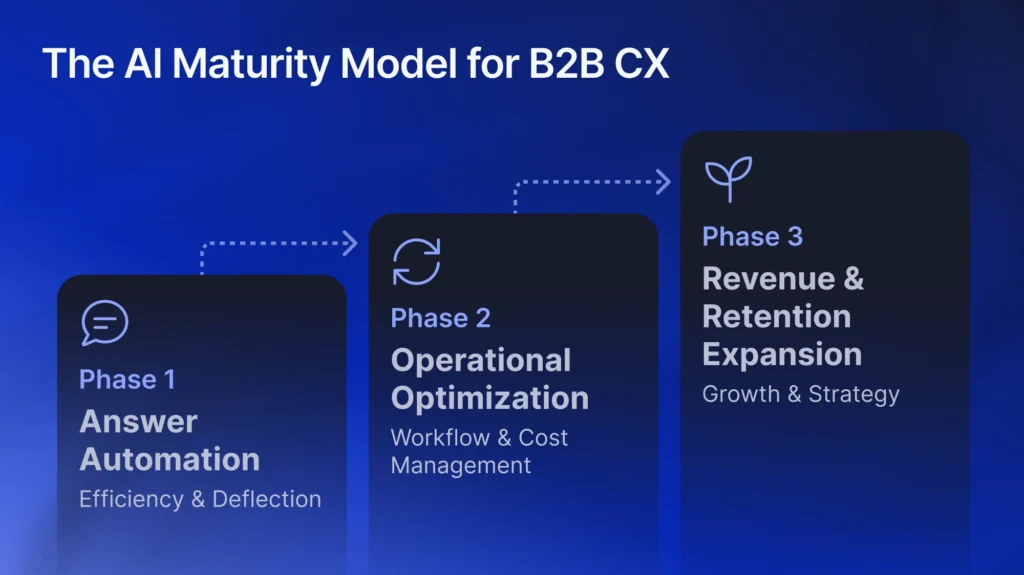
Agentic AI is redefining how CCOs and Support leaders think about Support, shifting it from a reactive cost center to a proactive driver of customer health and revenue. When agents continuously turn customer signals into intelligent action, Support can identify risks earlier, resolve issues faster, and engage customers at the right moment. The impact extends across both customer experience and business performance: reducing ticket volume through intelligent self-service, accelerating resolution times, improving consistency across interactions, supporting at-risk accounts proactively, and creating opportunities for retention and expansion. At the same time, human agents are elevated to focus on complex, high-value customer needs instead of repetitive work. The result is faster resolutions, fewer escalations, and more connected customer experiences that directly drive business impact.
Action: Measure and optimize for CX and business impact.
“Once we rolled this out internally, new hires stopped asking questions because everything was already surfaced for them. It became the fastest way to eliminate tribal knowledge and standardize best practices across teams.”
“Once we rolled this out internally, new hires stopped asking questions because everything was already surfaced for them. It became the fastest way to eliminate tribal knowledge and standardize best practices across teams.”
The future of CX isn’t just automated, it’s agentic.
Support now sits at the center of this shift and is uniquely positioned to surface the earliest signals of churn, expansion, and customer health. What was once viewed as reactive is becoming one of the most strategic sources of customer intelligence in the business.
TSIA notes, “Support organizations are no longer just viewed as cost centers. They’re strategic assets essential to customer retention, satisfaction, and growth.”⁷
We’re seeing this come to life through customers like Ironclad, WP Engine, and Impartner, organizations demonstrating what’s possible when AI agents are embedded into the way Support actually operates. Their progress continues to shape this playbook and push the category forward.
We hope that The AI CX Playbook helps your team take the next step, building agentic capabilities that transform customer issues into intelligent action and Support into a true engine for customer growth and business impact.